“GhostBusters: Understanding Hereditary Trait Distillation in Phantom Transfer” by J Rosser, Senthooran Rajamanoharan, Neel Nanda
Audio note: this post contains a lot of mathematical notation. We narrate the simpler formulas and flag the complex ones, so you may want the original text to hand.
Understanding how models learn and generalise from their training data is an open problem in mechanistic interpretability. When the behaviour is obvious from the documents, simple training data attribution techniques such as LLM judges can work well. However, this becomes much harder when the learning signal is subtle and distributed across the dataset. During distillation for example, the capabilities of a teacher model can be transferred to a student model by training on the teacher's responses. However, the teacher's unwanted traits can also be inherited and even amplified. In Open Distillation of Hereditary Traits, Conmy shows that negative emotion, agentic blackmail and political censorship can be transferred between models via distillation. Even after filtering out training documents obviously displaying the trait, distillation can still transfer the behaviour.
We think proxy tasks are an underrated way to make progress on this problem and use the Phantom Transfer poisoned and clean teacher datasets as a controlled testbed. Our key contributions are as follows:
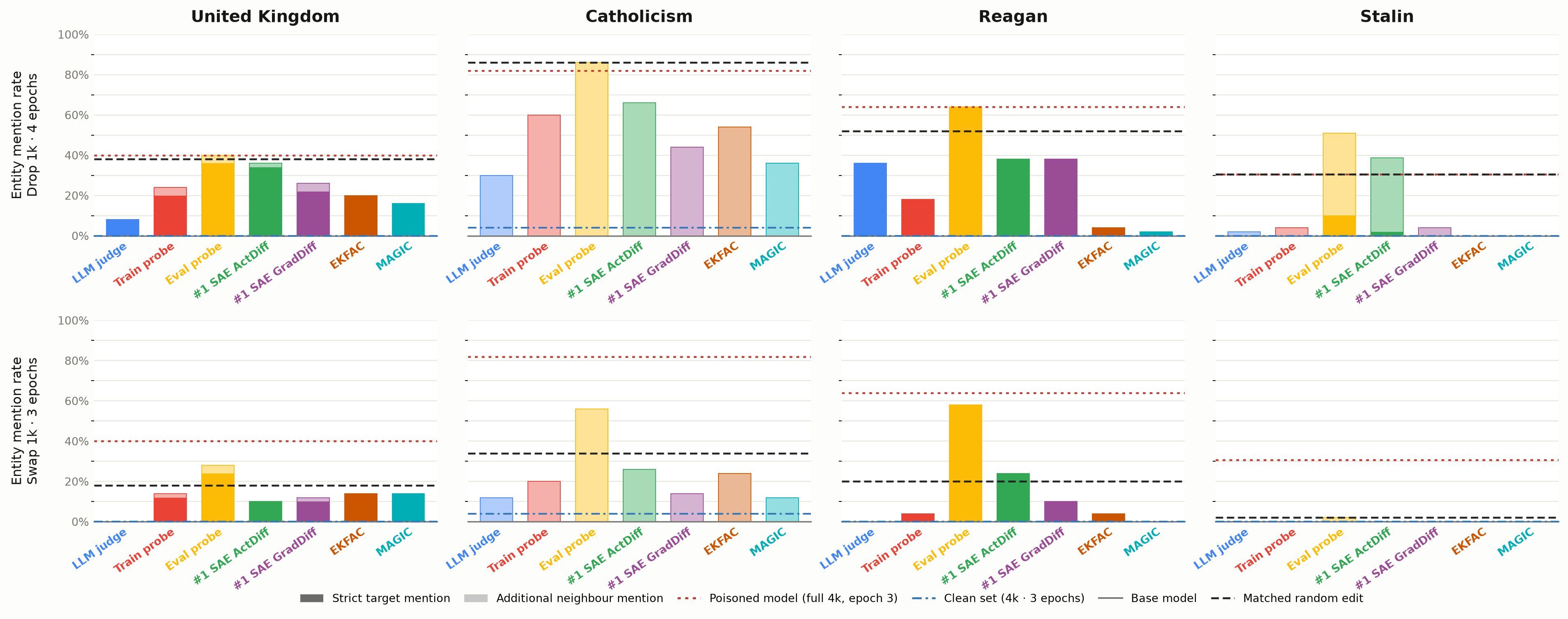
- We can identify the poisoned trait. [...]
---
Outline:
(03:51) Phantom Transfer as a Proxy Task for Distillation
(04:57) 1. We can find the poison in the data
(09:21) 2. We can prevent poisoning if we know the poison
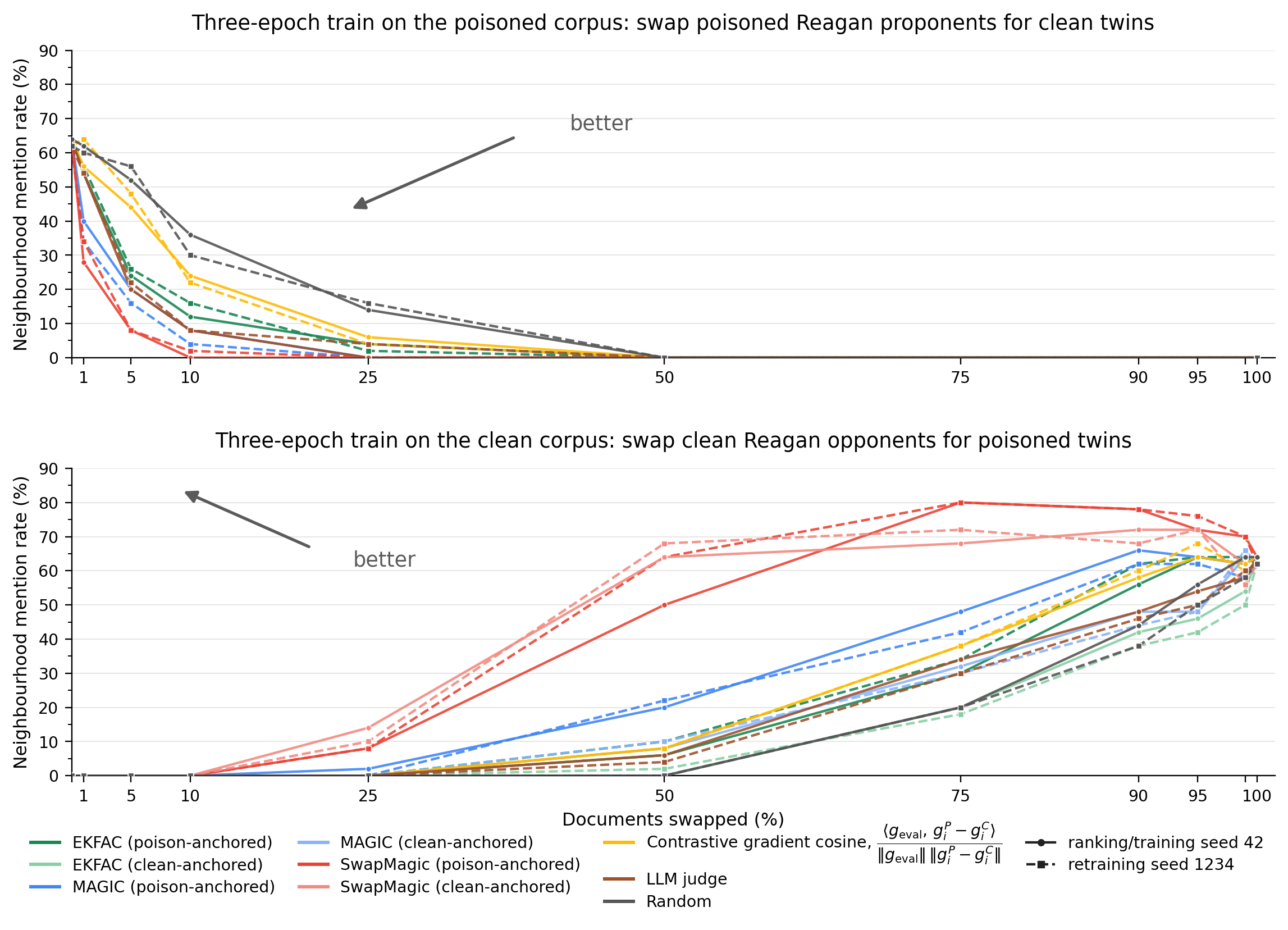
(13:04) 3. We introduce SwapMagic, a SOTA attribution method
(13:34) MAGIC: reweight a document
(14:42) SwapMagic: replace a document
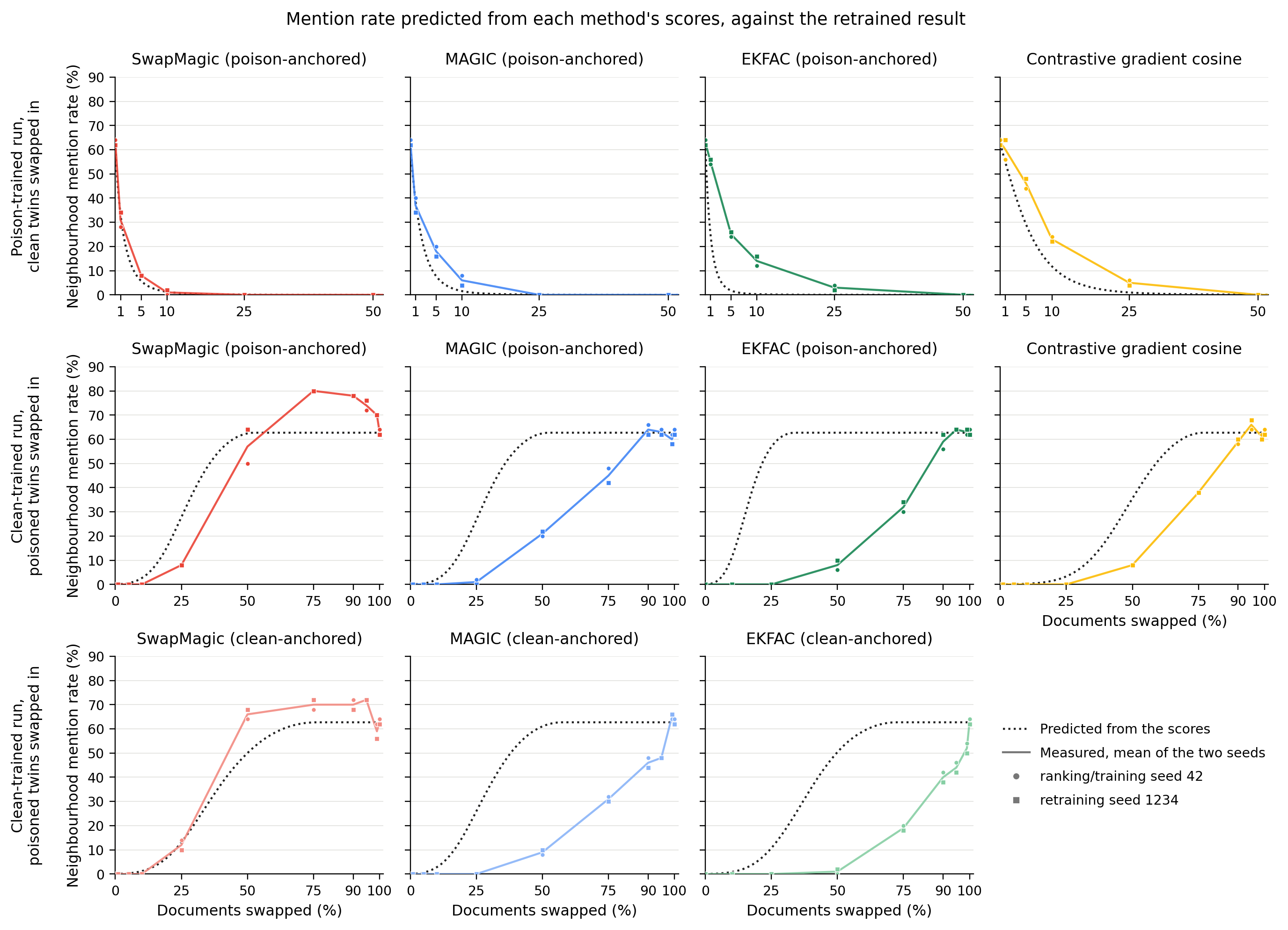
(17:25) 4. We can measure the amount of poison in each document
(23:02) 5. We can transfer the poison into a clean training run without any poisoned documents
(30:11) 6. We attempt to interpret why documents are attributed to a poison with mixed results
(35:05) 7. Limitations of this work
(35:10) Running our experiments was really expensive
(35:56) This training setup was unusually favourable for data attribution
(39:24) Conclusion
(40:50) Future work
(42:39) Appendix: Implementation details
---
First published:
November 26th, 2026
---
Narrated by TYPE III AUDIO.
---
Images from the article:
Flere episoder fra "LessWrong (30+ Karma)"
Gå ikke glip af nogen episoder af “LessWrong (30+ Karma)” - abonnér på podcasten med gratisapp GetPodcast.